
by Bruce Dunlavy
(An index to my other posts is available from the pull-down menus at the top of this page, and my blog home page and index of other posts may be found here.)
Since the beginning of his second term, President Donald Trump has been consistently increasing the temperature of his rhetoric about annexing Greenland to the United States. Emboldened by the swift and efficient invasion of Venezuela and capture of its president, Nicolás Maduro, Trump has turned even more insistent threats towards Greenland and its parent country, Denmark.
What is it about Greenland that piques such interest from this administration?
First, let us become acquainted with the territory itself. Greenland is big (although not so big as it appears on commonly seen Mercator projection wall maps). At 836,330 square miles, Greenland is the world’s largest island, and the northernmost land on Earth. It lies east and northeast from Canada, so far north that it is mostly ice-covered. Its population is a tiny 56,542, about 90 percent of whom are Inuit. Almost two-fifths of the residents live in the capital, Nuuk.
European settlement of Greenland – originally by Norwegians and Icelanders – began before 1000 C.E. When the union of Norway and Denmark was dissolved in 1814, its colonies, including Greenland, devolved to the Kingdom of Denmark, of which Greenland remains a part.
Considering its out-of-the-way location, inhospitable climate, minuscule population, expansive ice sheet, and a Gross Domestic Product (GDP) of less than three and one-half billion dollars, what does Greenland have that the United States wants?
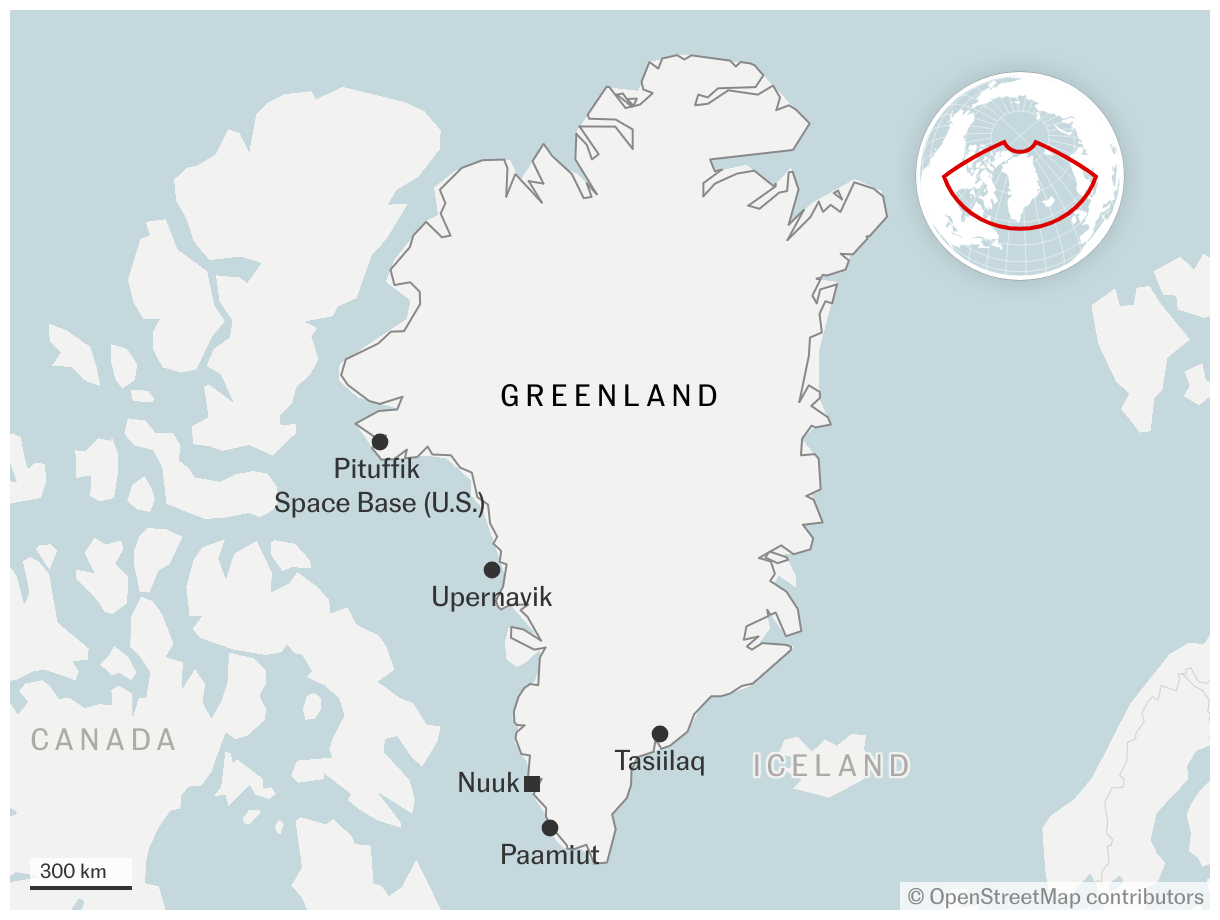
American designs on Greenland are both political and economic. Its location is strategic for the defense of north Atlantic shipping lanes, and it has deposits of minerals, particularly rare-earth metals that are crucial to high-tech development and manufacturing. Of course, the US is not the only world power interested in these assets. Additionally, the Trump administration has frequently expressed expansionist tendencies and a desire to broaden American political and cultural influences.
Resistance to US threats of annexation, by negotiation or invasion, is strong in both Greenland and Denmark. On January 14, 2026, the prime ministers of both lands met with US Vice-President JD Vance and Secretary of State Marco Rubio to discuss the issue. The American representatives were not swayed by the Greenlander and Danish efforts to persuade the US not to force annexation.
President Trump supports his annexation plan by citing Denmark’s inability to defend Greenland. That is undeniably true, as Denmark’s military would certainly be no match for Russian or Chinese takeover efforts. Denmark knows this; Greenland knows this.
However, Denmark is a member of the North Atlantic Treaty Organization (NATO), founded in 1949. All of NATO’s member states (including the US and nearly all of the biggest powers in Europe) are bound by treaty to defend one another by the NATO Charter’s Article Three.
In addition, the 1951 Defense Agreement between the two nations gives the US extensive latitude to establish military bases and install forces in Greenland. With the NATO Charter, the 1951 treaty, and the ability of American corporations to invest in and develop natural resources in Greenland as is done in countries all over the world, what would US ownership of Greenland provide that cannot be accessed now? If there is anything, including expansionism for its own sake, is it worth destroying NATO to acquire?
Perhaps there is another justification afoot here, tuning a string that this blog has plucked before, the good of the people. In an interview with BBC aired last week, Carla Sands, Foreign Policy Initiative chair for the America First Policy Institute and US Ambassador to Denmark in the first Trump administration, expressed grounds for the necessity of US ownership of Greenland.
Sands noted that Greenland is big (one-third the area of the US) and Denmark cannot defend it, both of which are noted above. She then argued for the benefit of Greenland’s people, saying they want prosperity, “good-paying jobs…and [the ability to accrue] generational wealth.” Previous posts here have pointed out this notion as problematic. It is a paternalistic attitude that has been part of American foreign meddling before, often with disastrous results.
An abrasive arrogance is constantly circulating in the US and periodically surfaces in foreign policy discussions. This arrogance is the conviction many of us have that everyone else in the world would rather be an American than whatever it is they are. Most Americans accept this with the viewpoint of former president Ronald Reagan, who in his Farewell Address in 1989 invoked the early American Puritan colonists. Reagan said, “I’ve thought a bit of the ‘shining city upon a hill.’ The phrase comes from John Winthrop, who wrote it to describe the America he imagined … God-blessed … that hummed with commerce and creativity, and the doors were open to anyone with the will and the heart to get here.”
Reagan was not the first to misinterpret the words uttered in 1630 by John Winthrop, Governor of Massachusetts Bay Colony, and twist them into a nationalistic celebration of a land chosen by God to be the model for rest of the world to aspire to. It is a common trope in American rhetorical history. But it is not what Winthrop meant.
Governor Winthrop said this: “For we must consider that we shall be a city upon a hill. The eyes of all people are upon us.” He meant what he said: the world is watching. The reference is scriptural, Matthew 5:14: “A city that is set on a hill cannot be hid.” Notice that Winthrop did not use the word “shining,” for he did not mean that America was to be a wonderful example for everyone else to aspire to. What Winthrop intended to convey is that the New World actions of the colonies would be observed by rest of the world. Observed not as an example to be emulated nor a goal to be pursued, but as an experiment to be assessed and judged according to its values and actions, be they noble or be they base.
 A GOOD MAN TO KNOW
always a good read
LikeLike