
by Bruce Dunlavy
(An index to my other posts is available from the pull-down menus at the top of this page, and my blog home page and index of other posts may be found here.)
Last weekend the military powers of the United States flew into Venezuela, attacked its capital city, and arrested its president, Nicolas Maduro, along with his wife. The two were flown to the United States and have already been arraigned in court in New York.
Many were surprised by these events, and many were not. President Donald Trump has been openly chasing a Nobel Peace Prize, but he has also been saber-rattling all over the world. Venezuelan ocean commerce has been the subject of regular US air strikes for many weeks, and the president has also threatened military action in Iran, Nigeria, and other nations.
The attack on Venezuela itself should not have been a surprise. Trump has made his intentions clear throughout the escalating military actions. On the first day of this administration, Trump signed an executive order declaring that street gangs (including Venezuela’s Tren de Aragua) to be “foreign terrorist organizations,” a designation normally applied to political groups such as al-Qaeda or ISIS.
By August, the US military presence in the Caribbean had grown to include numerous assault vessels and aircraft, along with several thousand troops. On September 2, the first destruction of a civilian watercraft occurred, with Trump explaining – without evidence – that target was a Tren de Aragua boat transporting narcotics from Venezuela to the US. A missive from the Senate Armed Services Committee to the administration complained that American military forces do not have the authority to “hunt down suspected criminals and kill them without trial.” Nothing came of the complaint.
After more attacks, Trump declared on October 2 that drug cartels were “unlawful combatants” with whom the United States was now in “armed conflict.” In other words, he asserted that any group declared by the president to be trafficking drugs into the United States was ipso facto engaging in an armed attack on America. Six days later, the Senate voted down proposed legislation to restrict presidential ability to unilaterally conduct military strikes against drug cartels, with two Republicans voting in favor and one Democrat voting against.
On October 15, President Trump announced that he had begun consideration of military actions on land inside Venezuela, and on the 24th the world’s most advanced aircraft carrier, the U.S.S. Gerald R. Ford, was dispatched to the area. The attacks on civilian boats continued apace, totaling 22 by the fourth of December. Six days later the U.S. Navy seized a Venezuelan oil tanker, arguing that it was carrying oil to terrorist groups. On the 16th, Trump ordered a blockade of all “sanctioned” oil tankers heading to or leaving Venezuela. The next day, the House of Representatives voted on two Democratic proposals to require that any further such actions against drug organizations would require Congressional approval under the War Powers Act. The proposals were defeated, largely along party lines.
The air strikes on civilian boats continued unabated, including both Caribbean actions and attacks in the eastern Pacific. On December 30, a drone strike on a docking area was the first direct attack on Venezuelan soil. The next day, Maduro said he was open to negotiating with the US to combat drug smuggling. Two days later came the attack that captured Maduro and his wife.
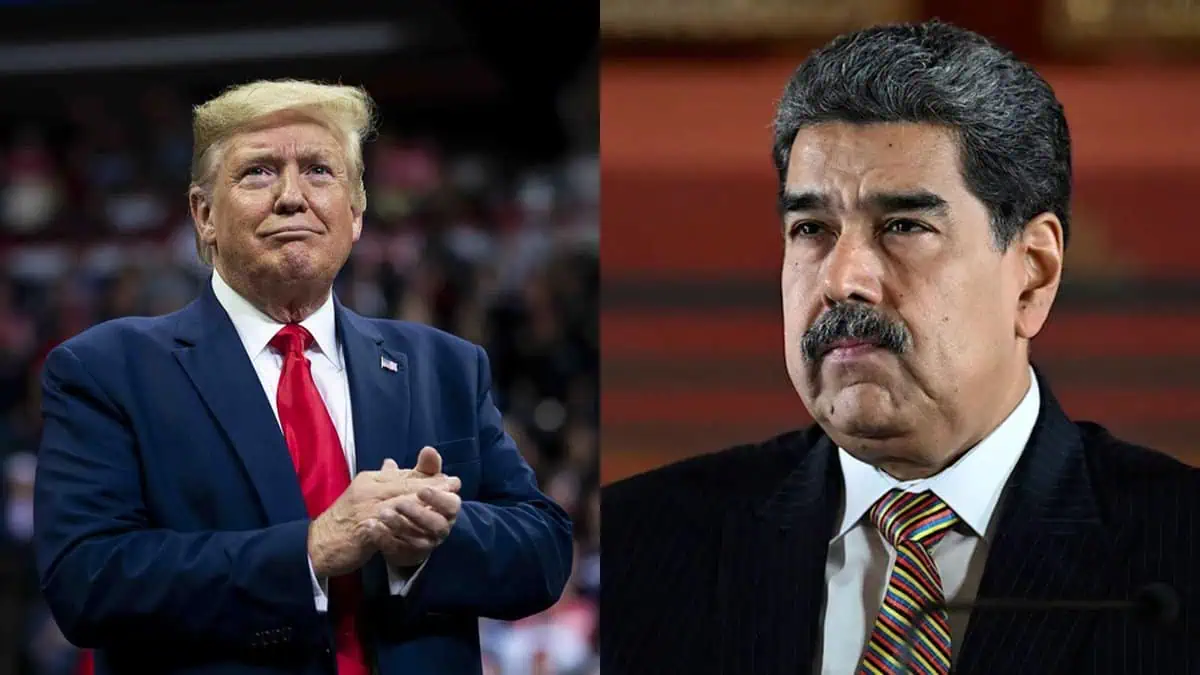
Image credit: siasan.com
The events leading up to the arrest of Maduro should have made American intentions clear. A series of announcements designating anyone deemed a trafficker in narcotics to be an “enemy combatant in an armed conflict.” Three months of military attacks on at least 35 non-military watercraft resulting in at least 115 deaths. Multiple oil tankers seized, embargoed, and blockaded. Venezuelan airspace declared a “no-fly zone.” Each step ratcheted up the action, as if probing to find out how far the plan could go with only negligible opposition.
Now the US has effected regime change in Venezuela, and Trump has announced that “we are going to run the country.” It took just under a year to get to this place. What will come next?
Does this all sound familiar? To historians it does. The US has a long history of intervention in Latin America and elsewhere to oust governments with which we do not agree. Usually, the stated reasons for our involvement are not the real reasons.
The administration was certainly disingenuous when it stated that Maduro had to be deposed because he was the head of a narco-state trafficking drugs into the United States. That is clearly shown by the action taken by Trump on December 1, near the end of the months of preparation for the removal of Maduro. On that date, Trump issued a pardon to Juan Orlando Hernandez, former president of Honduras. In March of 2024 Hernandez was convicted by a Federal jury of aiding drug traffickers for more than a decade by accepting bribes in return for facilitating the smuggling of over 400 tons of cocaine into the United States. Hernandez had been sentenced to 45 years in prison. He was freed the day after Trump signed the pardon.
Not long after Maduro’s arraignment, Trump gave an impromptu press conference on board Air Force One in which he made it clear that what he was thinking about was Venezuela’s natural resources, particular its large oil deposits. You can hear his remarks (and his concentration on the oil issue) here.
This is an echo of the sort of activity the United States has undertaken in the past, in Iran, Iraq, Congo, Vietnam, Afghanistan, Chile, and countless other places. Many of these involved countries bordering the Caribbean, including Mexico, Cuba, Haiti, Dominican Republic, Panama, Guatemala, Grenada, and more. Sometimes it was a quick move in to effect the ouster or assassination of a leader antipathetic to US business interests (Mossadegh, Trujillo, Allende, Noriega), but many times the result was a long, expensive, and in the end unsuccessful effort at nation-building (Vietnam, Iraq, Afghanistan).
Apparently, the latter course is to be attempted yet again. Alas, the US has shown itself to be not very good at nation-building. It was attempted in Vietnam, and after a horrific and disastrous war that lasted over a decade the Americans scrambled to get out just before the communist flag went up in Saigon. “We’ll never do that again!” we all said.
Nation-building was attempted again in Iraq, creating another decade of military presence in the same sort of quagmire. “We’ll never do that again!” we all said. It was tried again in Afghanistan, another decade of wasted effort, wasted money, and wasted human lives. “We’ll never do that again!” we all said.
Are we seeing a pattern here?
Venezuela has the largest proven petroleum reserves in the world, at least 300 billion barrels. However, nearly all of it is not the desirable light, “sweet” crude oil. Venezuelan crude is heavy and “sour,” with high concentrations of sulfur. It’s good for making asphalt, but the biggest profit in the oil business comes from the production of more thoroughly refined products. Sour crude requires a longer and more costly refining process.
In addition, Venezuelan oil is thick and heavy, meaning it is hard to extract and hard to convey through pipelines and refineries. The refineries and other facilities in Venezuela are not in good shape and will require restoration and repair. An increase in production will mean the installation of additional drilling and pumping facilities as well. What is the likelihood of US oil companies being willing to take the risk of big investments in Venezuela, especially given the circumstances that acquired their access?
President Trump has said that the US will “run Venezuela” for the foreseeable future. How that is to be accomplished is uncertain. Merely installing a superstructure at the top of the government there cannot be sufficient. Trump appears to be imagining a rosy scenario in the style of George W. Bush’s belief that American troops invading Iraq would be viewed as “liberators” by the Iraqi people. That was not the case, and the US presence there became more and more complex, more and more expensive, and more and more mistrusted as the period of occupation rolled on. Military forces were deployed and suffered casualties year after year.
The outcome of this occupation may follow a similar path. Venezuela has been under the rule of Maduro and his cohorts since April of 2013, when he became the nation’s president. Maduro ascended from the office of vice-president upon the death of Hugo Chavez, who had been president since 2002. For nearly 24 years the party of Chavez and Maduro has run Venezuela. The Venezuelan “deep state” of government operations is firmly entrenched and is not going to flip the switch and start following orders from a new top management of foreigners and former dissidents. Considerable US military presence will likely be required, as well as the establishment of a system of enforcement. Such presence will be promoted by American military leaders seeking to get their professional tickets punched.
How will the rest of the world respond to all this? Perhaps some countries may refuse to import oil from an occupied Venezuela. Other nations in the Western Hemisphere may become nervous about potential US intervention and seek assistance from elsewhere. The blatant way in which the United States entered Venezuela and overthrew its government reinforces a long-held view in nations with abundant natural resources that the US is always hovering over foreign governments, ready to change them if they are not satisfactory to American interests.
Foreign expansionist nations may see the US takeover as an opportunity – and perhaps a challenge – to engage in the same sort of action themselves. After watching the United States invade Venezuela and announce its intention to “run” it, what might China be thinking as it eyes Taiwan? Or Russia as it thinks about “taking up the Slavic burden” again in Eastern Europe? Military buildup is increasing worldwide. Trump has been insistent about NATO countries spending more on defense. As Napoleon is reported to have observed, you can do anything with bayonets except sit on them. Increasing armaments means increasing the likelihood of using them.
What’s next? Only time will tell.
 A GOOD MAN TO KNOW